Combining Metering and Regulation
This package has to carry six subsystems at once, each with its own space and access demands:
- Filtration
- Pressure regulation
- Safety protection
- Flow measurement
- Instrumentation
- Isolation capability
Balancing Pressure Control, Gas Measurement, Safety, and Maintainability
A Metering and Regulating Station does two jobs that don't usually share a skid: it brings gas pressure down to a safe operating range, and it measures exactly how much gas is going through. This concept design worked out how to fit both functions — plus filtration, instrumentation, and an independent safety layer — into one package that's still realistic to fabricate, operate, and maintain.
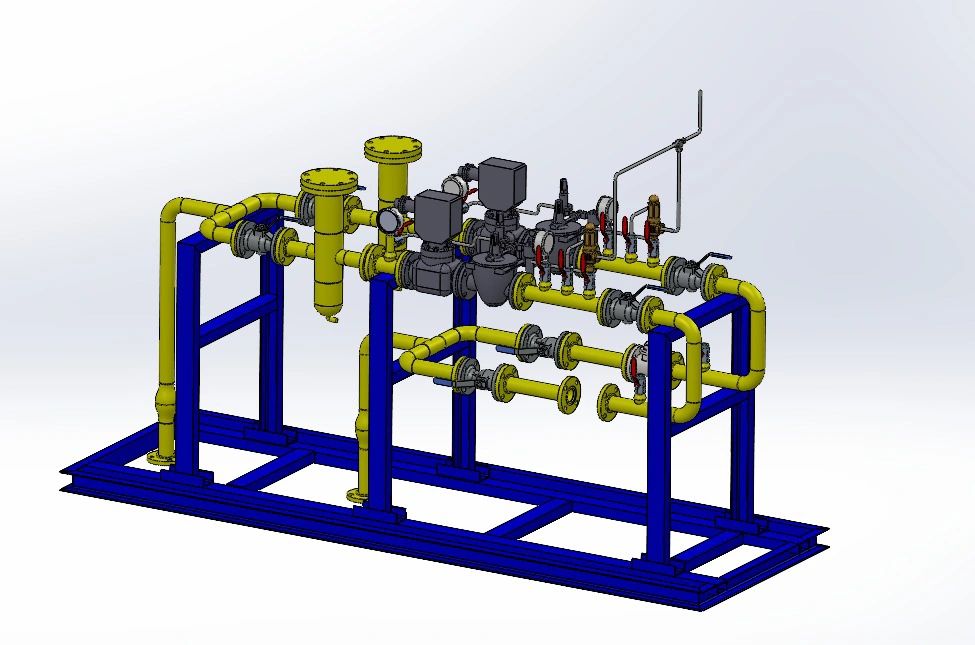
An MRS sits at the handoff point between gas supply infrastructure and the customers it serves. Its job is to bring incoming pressure down to a usable range, measure consumption accurately enough to bill on, and protect everything downstream if conditions go outside normal limits — all at once, all the time.
This was a concept-stage design, which sounds like it carries less weight than a construction-ready package, but in practice it asks for more judgment, not less. There's no finished P&ID to fall back on yet — every choice about equipment arrangement, maintenance access, safety philosophy, and skid constructability has to be reasoned through from the requirements up.
The scope here wasn't to drop components into an enclosure and call it done. It was to prove that pressure control, gas measurement, instrumentation, and safety protection could live together in one coordinated system — one that a workshop could actually build and an operator could actually maintain.
Reduce incoming gas pressure in a controlled, stable manner.
Measure gas consumption accurately enough to support billing and monitoring.
Keep routine inspection and maintenance achievable without dismantling adjacent equipment.
Fit the station within a practical, compact footprint.
Leave room for future instrumentation upgrades without a major redesign.
An MRS carries more functions in one skid than a simple regulating station does, and each extra function pulls the layout in a different direction.
This package has to carry six subsystems at once, each with its own space and access demands:
Every component added to the package makes the layout harder to keep clean. Left unchecked, a dense arrangement creates maintenance access problems, instrument visibility issues, and fabrication headaches that show up later, not on the drawing.
Shrinking the footprint looks like a win on paper, but excessive density tends to cause operational problems down the line. The design had to favor working space over raw compactness wherever the two were in tension.
Combining metering with pressure regulation means more isolation points, more instrumentation, and more places where a failure could propagate — the safety philosophy had to account for the whole package, not just the regulator train.
A concept that only works as a 3D model is incomplete. Every layout decision was weighed against what a workshop could realistically build, transport, and install.
The concept came together around a logical process flow first, with congestion control as a constant check rather than a final cleanup pass.
Major equipment was positioned to follow the actual gas flow sequence, so anyone looking at the skid can trace filtration through regulation to metering without mentally rerouting the layout first.
Routing decisions were made to:
Instrumentation positions were chosen with four things in mind:
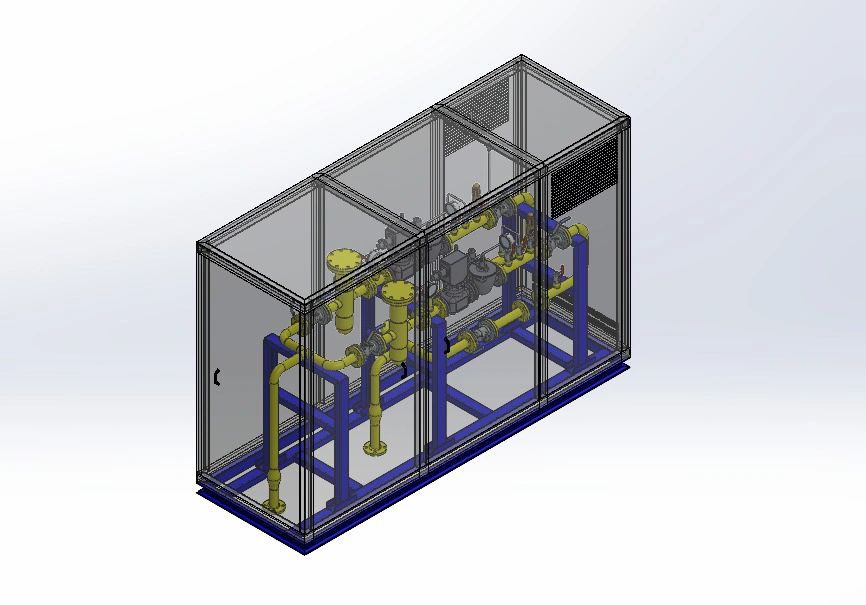
The enclosure was sized for more than physical protection — ventilation, accessibility, and operational safety all had to work together inside the same shell.
These are the calls that shaped the layout — and the reasoning behind each one.
Keeping the two functional zones distinct cuts congestion around the most sensitive equipment and lets a technician work on the meter without climbing over the regulator train, or the reverse.
Operational reliability doesn't stop at equipment selection. Even well-specified instruments become a liability if a technician can't reach them to inspect, calibrate, or replace them when the time comes — accessibility was treated as a hard requirement from the start, not a nice-to-have.
A simpler layout costs less to fabricate, reads more clearly to anyone troubleshooting it later, and tends to hold up better across the station's service life. The minor footprint savings from a denser layout rarely outweigh those long-term benefits.
Instrumentation needs change over a station's lifetime, and a layout that can't absorb an upgrade without a redesign becomes expensive fast. Leaving deliberate margin in the arrangement was cheaper at the concept stage than it would be after construction.
The clearest lesson from this concept was that good engineering tends to go unnoticed — people only register a station when it fails to work the way they expect.
Equipment arrangement has a direct, lasting effect on how easy the station is to keep running.
A compact design is only a win if it doesn't trade away operational safety to get there.
Practicality has to enter the conversation at the concept stage, not after the layout is locked.
Metering deserves the same attention as pressure regulation — it's not the secondary system.
A layout that anticipates upgrades avoids forcing a redesign the first time requirements shift.
Successful station design isn't about fitting components into available space. It's about building something that stays safe, logical, accessible, and reliable for everyone who fabricates, operates, inspects, and maintains it over its working life.
The skid frame and enclosed concept renders below. Additional views, P&ID references,
and fabrication photos will be added as the project moves forward — drop matching files
into assets/img/projects/ to fill these slots.
Practical support for piping and process design, pressure reducing stations, metering and regulating stations, gas train skids, CNG and hydrogen systems, mechanical design, technical documentation, and design review.