Isolation Valves
Placed at the points where the system needs to be cut off cleanly — letting the skid be shut down for maintenance without touching the rest of the line.
Industrial Natural Gas Pressure Control System
A gas train skid built to take incoming natural gas and deliver it to the burner clean, filtered, and at a steady pressure. The brief sounds simple on paper, but holding a stable downstream pressure while protecting the burner from upset conditions takes a deliberate mix of regulation, filtration, and independent safety devices — and a layout that someone can actually fabricate, ship, and service.
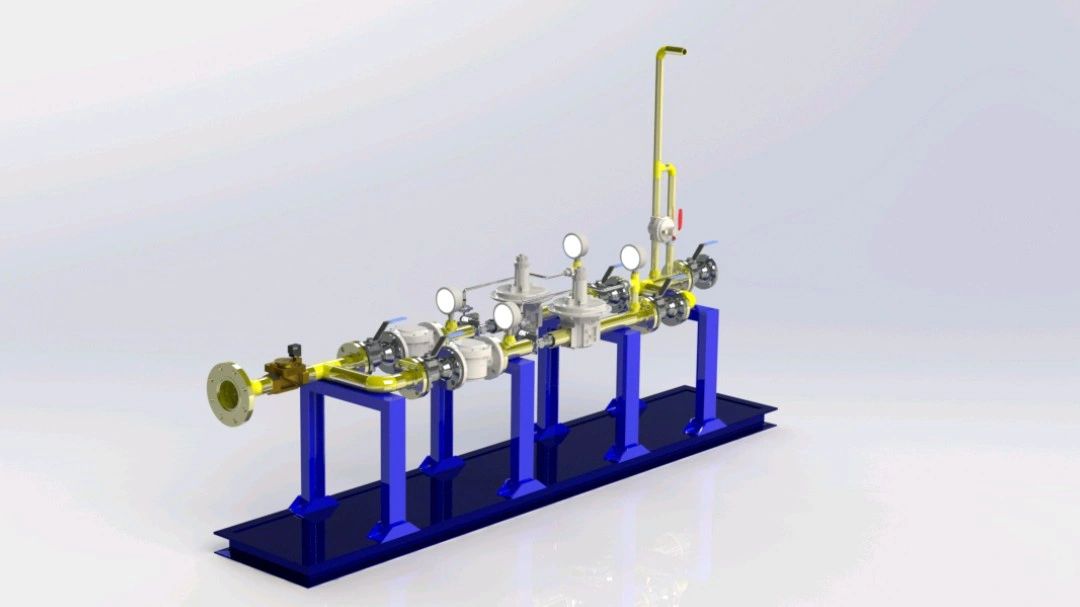
A gas train sits between the supply line and the burner, and its only job is to make sure what reaches the burner is clean, dry of debris, and at a pressure the burner can actually use. That sounds like a small ask until you remember that upstream pressure rarely behaves — it drifts, spikes, and varies with demand elsewhere on the network — while the burner expects something close to constant.
This project covered that full problem: regulating the supply, filtering out contaminants before they reach sensitive components, and backing the regulators with an independent mechanical safeguard in case something upstream goes wrong. None of those pieces work in isolation — sizing the regulators affects how the filter and slam shut valve are positioned, and all of it has to fit a skid that's still practical to weld, transport, and bolt down on site.
The scope ran the full distance from a 3D model and equipment selection to fabrication support and field installation — not just a drawing handed off to someone else.
Hold a stable downstream pressure regardless of upstream fluctuation.
Protect burner equipment from pressure spikes and surges.
Remove solid contaminants before they reach regulators and valves.
Provide an independent safety layer for abnormal operating conditions.
Keep day-to-day operation and maintenance straightforward.
Every component on this skid earns its place by doing one job well, and the six pieces below work together as a single integrated safety and pressure-control chain.
Placed at the points where the system needs to be cut off cleanly — letting the skid be shut down for maintenance without touching the rest of the line.
Strips out solid particles before they can score a regulator seat, jam a valve, or work their way down into the burner.
A two-stage reduction arrangement — each regulator only has to do part of the pressure drop, which makes the downstream pressure noticeably steadier than a single-stage setup.
A purely mechanical fail-safe. If downstream pressure climbs past its set limit, it snaps the supply shut on its own — no controller, no power, no dependency on the regulators it's backing up.
Mounted upstream and downstream so an operator can read the system's state at a glance, without needing to pull up a control screen.
Gives the skid a controlled path to relieve pressure, rounding out the overall protection scheme rather than leaving it to the regulators and slam shut valve alone.
Listing the equipment only tells half the story. The harder, more interesting part is why each piece is configured the way it is.
A single regulator dropping the full pressure in one step tends to hunt and overshoot, especially as flow demand changes. Splitting the drop across two regulators in series means each one operates closer to its sweet spot, and the downstream pressure settles faster and holds tighter. It also buys a measure of redundancy — the lead regulator absorbs most of the swing before it ever reaches the second stage.
Regulators are mechanical devices, and mechanical devices can fail or stick. The slam shut valve doesn't trust the regulators to behave — it watches downstream pressure on its own and closes the supply if that pressure ever exceeds the safe limit, with no shared failure path back to the regulation stage it's protecting against.
Equipment arrangement was driven by three things at once, not picked for looks:
A single regulator handling a large pressure ratio has to work across a wider control band, which makes it more prone to instability when flow demand shifts quickly. Dividing the drop between two regulators keeps each one inside a narrower, more predictable operating range.
Safety systems that share a failure mode with what they're protecting aren't really a second layer — they're the same layer twice. The slam shut senses pressure directly and acts mechanically, so a stuck or failed regulator doesn't take the safety function down with it.
A gas train looks compact on a drawing, but several decisions had to be worked through carefully before the design was ready to leave the screen.
Changing one regulator's setpoint or capacity shifts what the other stage needs to do — they had to be sized as a pair.
A layout that looks clean in 3D can still be awkward to weld or assemble; fabrication practicality was checked alongside the process design, not after it.
Filters, gauges, and valves all need periodic attention — the arrangement had to leave room to service each one without dismantling its neighbors.
Supporting fabrication and installation surfaced small fit and access issues that never would have shown up on a drawing alone.
Safety should never rest on a single layer of protection, and a design isn't finished until it's also easy to build, transport, and maintain — performance on paper and performance in the workshop have to agree.
The finished skid gives the burner a supply it can rely on — steady pressure, filtered gas, and a mechanical backstop that doesn't depend on the regulation system staying healthy. That combination cuts the chance of unplanned shutdowns from upstream pressure swings and protects downstream equipment from the kind of damage that's expensive to fix and disruptive to schedule around.
Just as importantly, the operator gets a system that's straightforward to read, isolate, and service — gauges where you'd look for them, valves where you'd reach for them, and a layout that doesn't punish routine maintenance.
The 3D model below. Fabrication and site installation photos will be added here as the
project documentation comes in — drop matching files into
assets/img/projects/ to fill these slots.
Practical support for piping and process design, pressure reducing stations, gas train skids, CNG and hydrogen systems, mechanical design, technical documentation, and design review.